Modernizing Retail Displays: Strategic Shifts in Storefront Design
MSD just dropped its "State of the Storefront" report, and if you're running a retail floor right now, the findings are a direct line into your Q4 strategy.
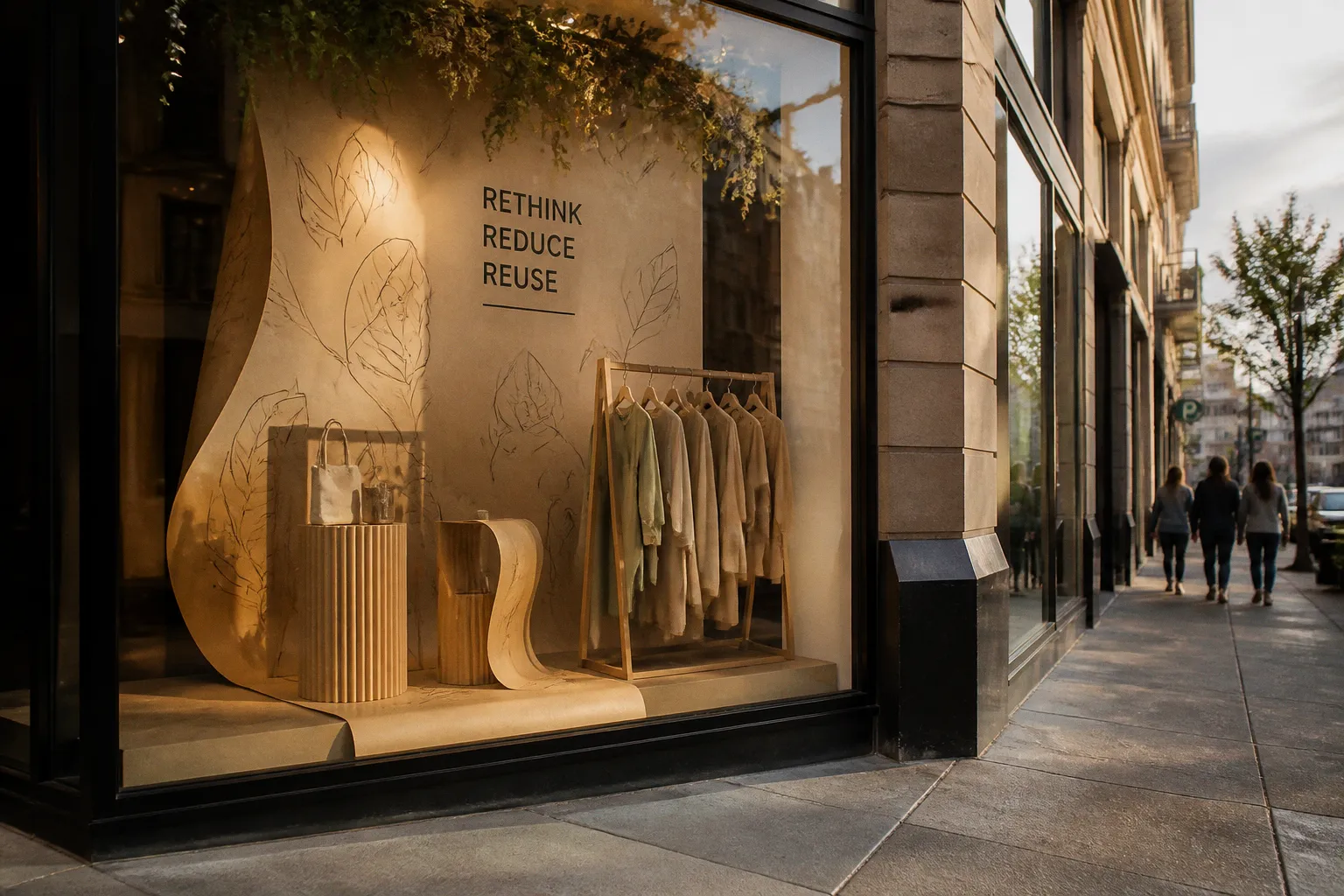
According to the publication, window design is pivoting hard toward story-driven narratives, sustainable paper-based materials, and modular builds you can reconfigure between seasons — three shifts that change how passersby stop, look, and ultimately walk through your door.
The three-second window still rules, but the toolkit has changed
Window designers have roughly three seconds to grab attention, and the report makes one thing clear: differentiation is the entire game. We see this on the floor every week — a clean sightline and a single powerful visual beat will outperform a cluttered tableau every single time. The trend the report calls "warm minimalism" is really about fewer props, cleaner palettes, and one unmistakable brand cue. Think of your best endcap. It doesn't shout, it speaks.
Modular fixtures make that discipline executable at scale. Instead of scrapping an entire window build between campaigns, you swap components in 48 hours. Paper-based and recycled materials aren't a marketing slogan — they're how production teams hit sustainability targets without burning budget on one-and-done builds.
Technology is the enhancer, not the headliner
The report walks through QR codes, responsive screens, motion-triggered content, and AR, and the smart framing from Macy's windows team is that tech should complement creativity, never replace it. That mirrors the instinct we bring to planograms: a digital screen layered into a fixture earns its rent only when it deepens dwell time or pulls a shopper deeper into the store. Drop a screen in just to have a screen, and you've added clutter, not conversion.
Interactive moments work best when they're tied to a measurable action — a scan that builds your CRM list, a motion trigger that nudges the customer toward a secondary display zone. If you can't connect the tech to a KPI, it stays decoration.
What this means for your floor — and your garment storage
Here's your quick storefront audit pulled straight from the report's themes:
- Can a passerby tell who you are in three seconds? Walk the sidewalk yourself and time it.
- Are your fixture builds modular enough to swap in 48 hours, or are you locked into a single-season design?
- Is every tech element earning its footprint with a measurable engagement metric?
- Are your materials spec'd for reuse, or are they headed to landfill after one cycle?
There's also an adjacent finding worth flagging. As reported, Austin-based Swann Closet Design recently released a breakdown of common errors homeowners make when planning their own closets — most notably hanging rods placed out of reach. It's a residential dataset, but the principle travels straight into our world of garment storage and display. Reach and sightline dictate turnover, whether you're merchandising a walk-in closet or a retail display wall. If the customer can't comfortably access that rod, that SKU is dead inventory hiding behind a fixture.
Keep your eye on how brands layer warm minimalism with interactive moments, and pressure-test every fixture decision against three questions: Does it extend dwell time? Does it strengthen brand recall? Can we reconfigure it for the next campaign without starting from zero? Those answers are how a window trend becomes store-floor revenue.